3 hours ago
As Officials Disparage Pretti and Good, Families of Black People Killed by Police Have Déjà Vu
Aaron Morrison READ TIME: 5 MIN.
The shooting deaths of white protesters Alex Pretti and Renee Good by federal officers in Minneapolis followed a playbook that is painfully familiar to Black Americans: Authorities quickly moved to disparage the victims, only to be contradicted as more evidence emerged.
Black families who have lost loved ones to police violence said the killings in Minnesota have brought back painful memories of their own fights for justice as law enforcement agencies spun up narratives to suggest officers had no other choice but to kill their relatives.
And these law enforcement agencies often make no effort to publicly correct misstatements or falsehoods that might have impact on a fair justice process, experts said.
Timothy Welbeck, the director of the Center for Anti-Racism at Temple University, said it “regrettably” took the deaths of Pretti and Good to again shine a spotlight on this issue.
“Black people have leveled a critique against law enforcement for as long as we’ve had policing in America,” said Welbeck, an assistant professor at Temple’s Africology and African American Studies Department.
He also called it “painfully ironic” that Pretti and Good died in “the same place” where other high-profile cases brought the issue to the fore: George Floyd, who was murdered in 2020 by a Minneapolis police officer, and Philando Castile, who was fatally shot in 2016 as he tried to show a suburban Minneapolis police officer his license to carry a concealed firearm.
Clarence Castile, an uncle of Philando Castile, said it was eerie to hear federal authorities make snap conclusions in the Pretti and Good shootings.
“Right away they backed up their officers and said they had justifiable shoots, their lives were in danger, they feared for their lives,” Castile said. “I heard the same thing, (officials) said the same things when that cop shot my nephew.”
“We know, from the beginning, that they haven’t taken the time to investigate," he said. "They’re just putting out something, because they think they have to respond. Sometimes the best response is no response.”
Leonard Sipes, who worked for 35 years in public affairs and communications for federal and state law enforcement agencies and is also a former officer, said the standard practice for shootings or any other major breaking case is to simply state that “it's under investigation.” Sipes said he typically waited 24 hours before releasing information to the public.
“Getting the story correct is vital to the reputation of the agency,” Sipes said. “You are also obligated to protect the integrity of the investigation. A rush to judgment can violate that.”
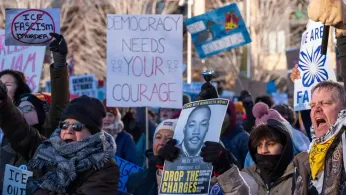
The killings of Pretti, a Veterans Affairs hospital ICU nurse, and Good, who described herself as a poet, mother and wife, quickly became rallying cries for Minnesotans protesting the largest surge of federal law enforcement into an American city.
After Pretti and Good were killed, administration officials from Homeland Security Secretary Kristi Noem to President Donald Trump claimed the two were far-left radicals acting with malicious intent to harm federal officers.
“The sickening lies told about our son by the administration are reprehensible and disgusting,” Pretti’s family said in a statement this week, noting that videos showed Pretti holding his phone, not a gun, when he was tackled by federal agents before he was shot several times. “Please get the truth out about our son.”
Good was remembered by her family as “the beautiful light of our family and brought joy to anyone she met.”
“She was our protector, our shoulder to cry on and our scintillating source of joy.”
While Justice Department officials have declined to launch a civil rights investigation into Good’s death, on Friday they announced a civil rights probe into Pretti’s killing.
Still, officials have not walked back claims that Pretti and Good were avowed extremists who intended to harm federal agents when they were killed.
Some Black activists and police reform advocates expressed frustration that people who are outraged by how the Pretti and Good cases have been handled often ignored the same dynamics when the victims were Black.
“Ultimately, this demonstrates the insidious nature of racism and how it’s embedded its ways into the systems and structures of society,” Welbeck said. “When Black people try to point out not only the logical fallacies of it, but just the callousness of it, we were often lambasted or told that we were overreacting and needed to wait for justice to play itself out.”
Melina Abdullah, co-founder of Black Lives Matter Grassroots, said it’s a common misconception that Black racial justice organizers won’t get active when white people die at the hands of law enforcement.
“I want to be very clear that I mourn and rage about the murder of Alex Pretti and Renée Good,” said Abdullah, organizer of a national hub for BLM chapters. “What they suffered is what Black people suffer every single day, and it doesn’t make it right for them, but it’s also not right for us.”
Justin Hansford, who participated in Black Lives Matter protests after the 2014 police shooting death of Michael Brown in Ferguson, Missouri, said the Minneapolis shootings should be a reminder to all Americans that injustice disproportionately impacting Black people can impact them, too.
“It’s the idea that Black folks were always the ones whose experience signaled to the rest of the country what was soon to come,” said Hansford, a professor at the Howard University School of Law and executive director of the Thurgood Marshall Civil Rights Center.
“It was because this is the Black experience that you looked at it narrowly, and you failed to address it. And then the experience becomes mimicked nationally.”
Tiffany Crutcher, the twin sister of Terence Crutcher, a Black man killed in 2016 by a Tulsa, Oklahoma, police officer, said she couldn’t watch videos showing the killings of Pretti and Good. Just hearing authorities speak about their deaths was re-traumatizing, she said.
She’s “been there before,” she said, recalling how law enforcement officials made snap judgements about her brother.
Crutcher's family maintained that Terence was in need of help after his vehicle stalled on the road. The officer who fatally shot him claimed she feared he was reaching into his car for a weapon. Terence Crutcher was unarmed.
Video footage from the scene recorded an operator saying Terence “looks like a bad dude” who “could be on something.” Ultimately, the officer who shot him was acquitted at trial for manslaughter.
“In our trauma and shock, we had to control the narrative about who Terrence was,” Tiffany said. “While we’re grieving and mourning, at the same time, we have to rally and let the world know that our loved one did not deserve to die.”
She said the Pretti and Good shootings are helping people wake up to the problem of unequal justice for people killed by police.
“Naturally, there’s an affinity more broadly towards law enforcement and people believing them," Tiffany said. “However, I think that is shifting.”
"Our voice is all that we have. And we made a conscious decision that we were going to utilize our voice and get ahead of the harmful narratives.”